
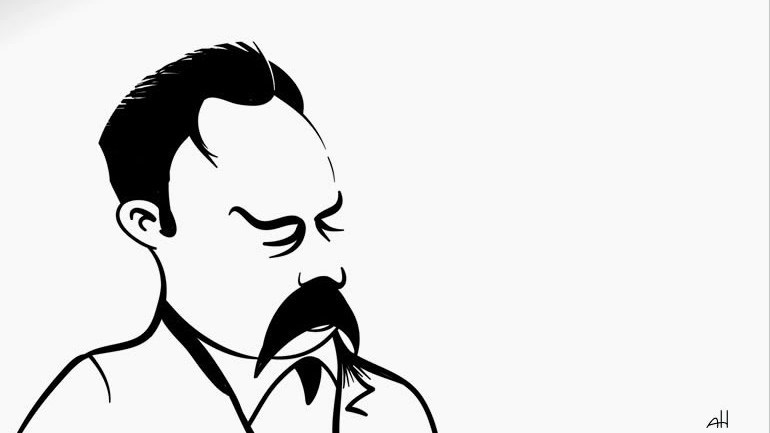


A brilliant young man, he was appointed professor at the University of Basel aged 24 having not even finished his degree. His evanescent philosophical life ended 20 years later when he went insane and died shortly afterwards.
Nietzsche’s argued that the Christian system of faith and worship was not only incorrect, but harmful to society because it allowed the weak to rule the strong – it suppressed the will to power which was the driving force of human character. Nietzsche wanted people to throw of the shackles of our misguided Christian morality and become supermen – free and titanic.
However, without God he felt that the future of man might spiral into a society of nihilism, devoid of any meaning; his aim was for man to realise the lack of divine purpose and create his own values. The core of Nietzsche’s work, including Thus Spake Zarathustra (1883-92), Beyond Good and Evil (1886), The Birth of Tragedy (1872) was to find a meaning and morality in the absence of God.
Most of you philistines are swines before pearls. Not worthy to indulge in the great do it yourself blueprint for life.
Can you reject the weak fragile values of your faiths and beliefs? Are you ready to admit of your true nature? I doubt it.
Since most of you crave simplistic metaphors and narratives as replacement for what you don’t understand, or is to complex, or to terrifying, then continue to shroud yourself in the lies and twisted denial of your simplistic spiritual how to guides, full of yearning for a paternal deity, you will continue to lie to yourselves about your true nature and that of others.
I am entertained by peoples consternation even frustration at Nietzsche’s writings, longing for a bullet point memo of Nietzscheanism.
The dionysian shall dwell regardless of the depth of shadow and smoke.
i cant watch the video, the video no longer available 🙁
Video is now fixed.
What about his sister and her dealings with the bad germans. She loved altering his writing to please those badies.
This guy was nuts but brilliant. How nuts was he? (Just kidding), how brilliant was he is the real question.
Nietzsche has done nothing for me!
This guy was nuts but brilliant
This guy was nuts but brilliant
This guy was nuts but brilliant
inspirational
Forgot to rate this documentary . . . I think it’s outstanding!!!
A very interesting documentary accompanied by beautiful audiovisual effects that complement the narrative provided by the various people who provide their commentary. I’m struck by the futility of Nietzsche and the paradoxical fame he received since I know that he missed the fundamental point of the symbolism embedded in Christianity. The idea that God is Dead is mentioned but not explained so I assume it’s based on the killing of Jesus Christ. While Christ is the Son of God and urged each of us to become the “Superman” Nietzsche mentions (i.e., we are the Children of God) by following his example. Christ said the Father and I are One as part of the Trinity which also includes the Holy Ghost . . . and as such I see no basis for concluding that Christ’s physical death equates to the death of God. Instead I see God as very much alive on the “other side of the mirror” while we and all Things on “this side of the mirror” are the collective fragments he divided himself into . . . a “kind of death” wherein each piece has the divine quality of choice to do good, learn from experience that “evil” is imaginary in that when our choices go against the “Good”, the Law meets out an effect Christians view as “Punishment” but creates in us the awareness that influences us to make more positive decisions in the future decisions; thus turning what we think is bad or evil into a “Good”. This is consistent with the Bible’s pronouncement that God is Good, God is All, two equations that yield “All is Good” which supports my contention that “Evil” is imaginary, a premise Nietzsche failed to consider.
How could anyone get a more erroneous apprehension of that excellent biography than you Karl May? “God is dead” has nothing whatsoever to do with the crucifixion of Jesus . . . it means that the idea that “god exists” has been killed/annihilated/finished, finally! It’s not that complicated.
Good grief, man. Gain a basic grasp of your subject before you post an ill-informed, illogical rant like this one. I was embarrassed for you just reading it.
Good grief, man. Gain a basic grasp of your subject before you post an ill-informed, illogical rant like this one. I was embarrassed for you just reading it.
You assume? Organised around you’re interpenetration of other peoples interpenetration of the work of Nietzsche, think things through before you write. At least put some effort in and read his works before criticize him.
None of this matters though really, I only looked at the comments section wondering if there would be a disjointed rant about how he failed or some impact on Christianity; how brilliantly you captured that spirit.
Well done you.
A+ for effort.
Thanks for balanced comment from a Christian.
You assume? Organised around you’re interpenetration of other peoples interpenetration of the work of Nietzsche, think things through before you write. At least put some effort in and read his works before criticize him.
None of this matters though really, I only looked at the comments section wondering if there would be a disjointed rant about how he failed or some impact on Christianity; how brilliantly you captured that spirit.
Well done you.
A+ for effort.
Thanks for balanced comment from a Christian.
You don’t get it. Christ’s death didn’t mean the end of god. in any way. By the “end of God” means for people to be liberated from the confines of ignorance through religion.
I feel like this documentary portrays a very weak version of Nietzsche, and not the kind of man who suffered for years on end while publishing some of the most beautiful statements in the German language.